
Corozal
Historical Overview
Corozal municipality was established on April 27, 1795, when residents petitioned for independence from its mother town of Toa Alta; it attained full town status by 1804 upon completion of its church, government buildings, and civic infrastructure. The parish of La Sagrada Familia (Holy Family), founded alongside the municipality and falling under the Diocese of Arecibo, holds the earliest Catholic records for the area, though these records are not digitized and must be requested directly from the parish for events prior to 1876. Situated at the northern edge of Puerto Rico's Cordillera Central, Corozal was a settlement zone for families from surrounding interior towns, making its baptismal, marriage, and burial registers vital for tracing lineages across the central mountain region. Civil registration began in 1885, providing a complementary documentary record alongside the earlier parish registers.
Coat of Arms

Image: Wikimedia Commons (CC BY-SA 4.0)
Three corozo palm trees representing the town's name and river margins, mountain peaks reflecting the striking terrain, blue-and-silver waves standing for the Corozal River, gold nuggets recalling historic gold panning, and a mural crown as the civic emblem of the town.
Barrios
Genealogical records often identify individuals by barrio. Corozal has 13 barrios:
Neighboring Municipalities
Also check records in neighboring municipalities:
Historical Maps
Historical maps help identify barrios, boundaries, and communities as they existed in the past. Maps from the 18th and 19th centuries are preferred.
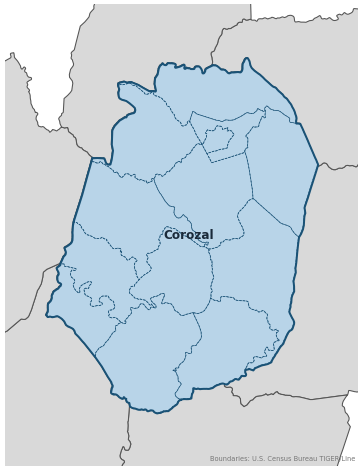
Corozal (2026)
Genealogy Toolkit
Diocesan Archive
Diocese: Diocese of Arecibo
For sacramental records not available digitally, contact the diocesan archive directly.
Diocese WebsiteDigital Archives
- FamilySearch: Corozal Civil and parish records
- Puerto Rico, Catholic Church Records, 1645-2021 Church Records Island-wide Catholic collection including baptisms, confirmations, parish censuses, marriages, deaths, and indexes from parishes across Puerto Rico.
- Find A Grave: Corozal Municipality Cemeteries Cemetery Records Browse and search burial records across Corozal's cemeteries, including Cementerio Municipal de Corozal, Cementerio Urbano, and Corozal Memorial Park.
- Puerto Rico Civil Registration, 1885–2001 Digitized Records Civil registration births, marriages, and deaths for all Puerto Rico municipalities including Corozal, beginning 1885.
- Puerto Rico Historic Buildings Drawings Society — Parroquia La Sagrada Familia, Corozal Heritage Archive The oldest and primary Catholic church in Corozal is Parroquia Sagrada Familia de Nazaret (Holy Family Parish), located in the town center facing the central plaza. The original parish structure was established in 1804 when Corozal was officially founded as a municipality. The existing historic building dates to the 19th century and is a focal point of the town heritage and architecture. Includes architectural drawings of the front facade.
- Parroquia Sagrada Familia Corozal — Facebook Parish Social Media Official Facebook page of Parroquia Sagrada Familia in Corozal. Useful for current parish contact information and community announcements.
- FamilySearch: Puerto Rico Genealogy Complete records guide
Further Reading
- U.S. Census Bureau: Corozal Municipio Profile — U.S. Census Bureau Census Data Authoritative 2020 Census profile for Corozal, including official barrio list, population data, and geographic boundary information.
- Corozal, Puerto Rico Genealogy (FamilySearch Wiki) — FamilySearch Research Guide FamilySearch wiki page for Corozal with links to civil registration and Catholic church records; directs researchers to contact the local parish for records prior to 1876.
- Registros civiles de Corozal, 1885-1994 (FamilySearch Catalog) — FamilySearch Vital Records Civil registration catalog for Corozal covering births, marriages, and deaths from 1885 to 1994.
- Municipio de Corozal (Enciclopedia de Puerto Rico) — Fundación Puertorriqueña de las Humanidades Municipal History Authoritative overview of Corozal's founding, geographic context, and administrative history, including confirmation that the area was under Toa Alta's jurisdiction before achieving independent town status.
Found an error or have additional information? Contact us